1C
LONG-RANGE
PRECISION SHOOTING
Interest
in long-range precision rifle shooting now stands at an all-time
high. Yet, the vast majority of prospective aficionados with whom
I speak all say the same thing – they'd love to get involved
in it, but haven't any idea how to go about it. "It's too hard
– I'm not a good enough shot and I don't know how to get started,"
is perhaps the most common response. But is it that difficult? Is
long-range precision shooting so tough that only a few expert marksmen
can handle it?
The answer is
simple – no, it isn't. With proper equipment selection, set-up,
load development and practice, long-range precision riflery isn't
nearly as difficult as most believe. The problem is that they don't
know too many fundamental things that critically influence performance,
thus fostering the idea that it's too tough for the average guy.
For the last
seven years, I've been involved in this kind of shooting almost
full-time. And, along the way, I've discovered not only how to achieve
the kind of results we all dream of, but, I think, broken some new
ground as well. Like any other kind of shooting endeavor, long-range
work first involves a careful analysis – defining the questions
before seeking answers, if you will.
Often, this
isn't as easy or simple as you might think. For example, what is
long-range? 400-meters, 500-meters? 750-meters? A thousand, perhaps?
As inane as this might at first appear, the question must be answered
before you can proceed efficiently. The question means different
things to different shooters. Thus, a better way of phrasing it
might be, "What is long-range precision shooting to you?"
If your needs
dictate a maximum engagement range of no more than 500-meters, you
can include some of the smaller cartridges in your list of possibilities.
For this kind of work, the .223 (5.56x45mm NATO), .22-250 Remington,
.243 Winchester, 6mm Remington and .257 Roberts are capable of excellent
performance.
If you require
longer-range capability, say out to 600-meters, the .257 Ackley,
.308 Winchester (7.62x51mm NATO) and .30-06 are good choices. Both
are capable of excellent accuracy and possess satisfactory terminal
ballistic capability out to this distance.
Ranges past
600-meters require a flatter trajectory than most cartridges can
produce, so cartridges like the .257 Weatherby, .270 Winchester,
.270 Weatherby, 7mm STW, .30-338, .300 Winchester and .300 Weatherby
are a better choice.
Yes, I know
that some great shots at these distances have occasionally been
made with lesser cartridges, but from my perspective, accuracy alone
isn't enough, especially against living targets. As far as I'm concerned,
terminal ballistics – the cartridge's inherent wound-producing
capability – are just as important. Almost any well-conceived
load is capable of sufficient accuracy to hit targets at distances
well beyond its terminal ballistic capability.
The problem
is that for either tactical or hunting functions, this simply isn't
enough – you've got to put that target down quickly –
incapacitate it – which means that you need more than lethality
alone. See? Right off the bat, you've got to determine your needs
before you can proceed effectively. A simple matter if properly
defined, but this is where most would-be long-range precision riflemen
get into trouble – they don't define their needs before seeking
solutions. I've found that once this is accomplished, efficient
long-range shooting is easier to understand and pursue. In fact,
it then becomes surprisingly simple, as long as you follow this
simple formula:
Select the proper
rifle type, caliber, sights and ancillary equipment.
Set it up properly.
Train with it
both on the range and in the field to ascertain that it is, in fact,
set up properly.
Continue to
train under real-world conditions.
Most shooters
believe that only bolt-action rifles are capable of the 1-MOA accuracy
generally considered to be appropriate for precision long-range
work, but this isn't entirely true. I've found that the AR15, for
example, is capable of nearly benchrest accuracy, provided it's
set up properly. Then, it's just a matter of understanding the limitations
of the .223 Remington (5.56x45mm NATO) cartridge it utilizes and
developing the best load combination for your purposes.
Proper set-up
includes:
Insuring that
the upper and lower receivers are tight.
Installation
of a free-floated, heavy barrel and handguard.
3. A "trigger
job," a clean, crisp release of the appropriate poundage for
your preferences.
You can easily
have an AR "done over" by any competent gunsmith or even
purchase a rifle already configured with these features. Of those
who build such guns, DPMS (13983 Industry Avenue, Becker NM 55308;
1-800- 578-3767; website http://www.dpmsinc.com email dpmsinc@aol.com
is my favorite, having provided me with no less than five various
precision AR15s, all of which consistently shoot under ½-MOA.
Under The banner of Panther Arms, They offer no less than a dozen
such rifles, my personal favorites being the:
"Sweet
Sixteen" -- with a stainless, free-floated heavy barrel, vented
aluminum handguard and adjustable trigger.
"Panther
Bull" – featuring a 20-inch fluted, free-floated heavy
barrel, several different upper receiver configurations and an adjustable
trigger.
"Panther
Bull 24-Special" – a "full-house" 24-inch,
free-floated heavy barreled piece with a vented aluminum handguard,
adjustable trigger, specially configured pistol grip and buttstock
and multiple upper receiver variations.
"Arctic
Panther" – A "winterized" version of the Panther
Bull, with its upper and lower receivers and handguards finished
in white for use in the snow.
"Low-Pro
Classic" – an economical version of the Sweet Sixteen,
with a 1-inch non-free floated, target-crowned, heavy barrel, an
investment cast lower receiver and beefed up upper receiver to aid
in barrel-receiver rigidity.
I know what
you're thinking -- they'll cost you an arm and a leg, right?
Nope. All of them retail for between $655 and $1200, far less than
comparable rifles from most other makers which, in my experience,
don't shoot nearly as well even if some of them cost nearly twice
as much.
There are also
a number of self-loading rifles chambered for the .308 Winchester
(7.62x51mm NATO) capable of 1-MOA accuracy if properly set up. I
have several FN-FAL and Springfield Armory M-1As (the civilian version
of the US M14) that shoot very, very well. Multiple barrel contact
points, sliding op rods and such make better accuracy elusive, but
1-MOA is in fact enough, especially in the field where conditions
are far less than ideal. Again, as long as the upper and lower receivers
are tight (FN-FAL) or the action in the stock (M-1A) and the weapon
has a decent trigger, they'll produce surprisingly accurate results.
Though I have
a number of precision bolt-action rigs built on the Winchester M70
or Mauser M98, Remington's M700 series has proven to be by far the
best. With nearly any good heavy barrel (I use target-crowned Douglas
Supremes and McGowan stainless barrels with excellent results),
a free-float job, synthetic stock (I've found H&S Precision
and MacMillan to be the best) and a 1¾-lb. trigger, my M700s
consistently produce 3-shot Ransom Rest 100-meter groups of from
¼ to no more than ¾-MOA, depending upon the cartridge
for which the rifle is chambered.
If you don't
want to bother with custom work or find its cost prohibitive, then
I suggest you obtain a Remington M700 Sendero (long action) or M700
VS (short action). These are already equipped with a black or gray
synthetic stock designed by H&S Precision, a 24 or 26-inch heavy
barrel, adjustable trigger and are matte finished.
Calibers for
the M700 VS include the .223 Remington, .22-250 Remington and .243
Winchester, while the M700 Sendero is available in .25-06, 7mm Remington
mag and .300 Winchester. If you prefer a cartridge other than these,
simply have the rifle re-barreled to your own specifications, thus
considerably reducing expenses.
If your rifle
is new, a barrel break-in process is important. First, do not get
it too hot – heat causes quick chamber throat erosion and
accuracy loss. Second, although some go so far as to clean the rifle
after each shot for the first hundred rounds, I've had great results
by cleaning it after each 25-rds.
My first time
in Africa back in the 1970s, my professional hunter remarked to
me that he could easily spot an American hunter because he carried
a thousand-dollar rifle with a hundred dollar telescopic sight on
it. Being an expatriate Brit, I at first thought the comment was
just part of his dry wit, but subsequent observations of other hunters
in the field showed that there was substantial basis for his claim.
Such is also often the case with precision long-range shooters as
well.
Though many
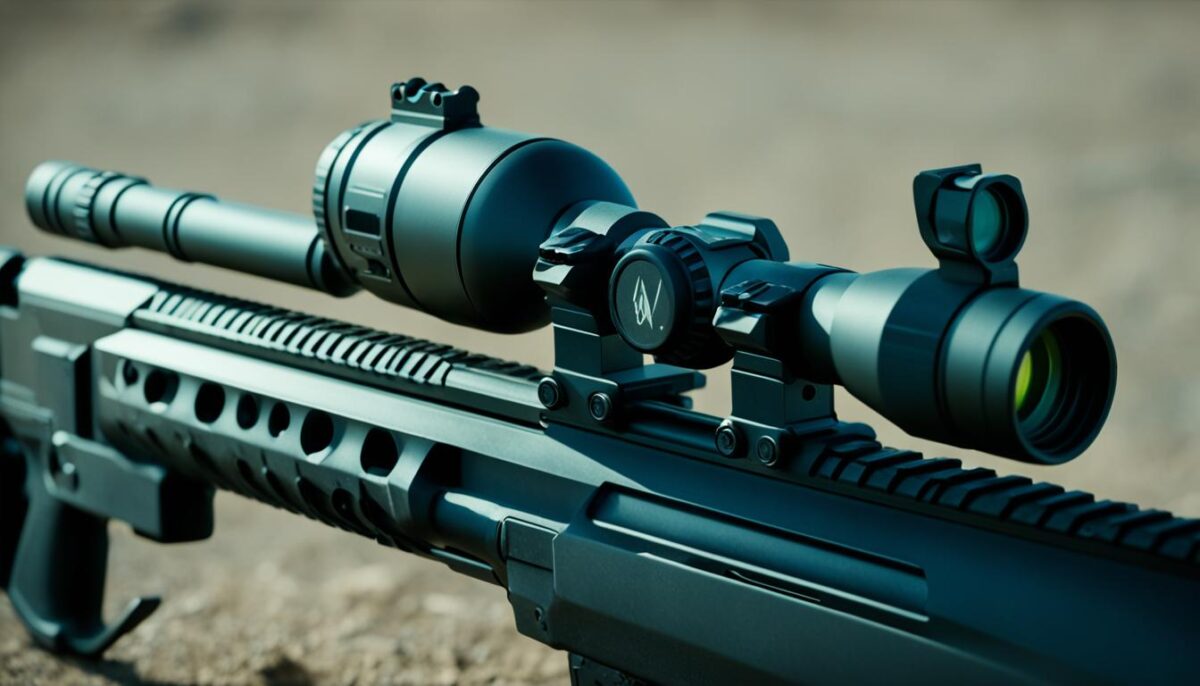
would-be long-range precision shooters don't realize it, scope selection
is fully as critical as rifle selection. The scope must provide
the right magnification for the user's needs, possess good light-gathering
and amplification capability and be as clear as possible, yet not
be too heavy or bulky. It must also have finite, yet positive, elevation
and windage adjustment capability.
This narrows
the field considerably, for me, to the point where there are only
two kinds American scope to consider – the Leupold (PO Box
688, Beaverton, OR 97075-0688; 1-503-526-5195; www.leupold.com 3-9x40mm
VX-II and 3.5-10x40 or 50mm or 4.5-14x40 or 50mm Vari-X III Tactical
series. Matte-finished and as light and compact as possible, they
offer not only bright, clear optics and ruggedness, but exhibit
the best "user friendliness" obtainable. Their ¼-MOA
click adjustable turrets are also well protected and clearly marked
for quick, easy field use and allow precise zeroing and efficient
subsequent calibration out to the shooter's "max effective"
range.
The VX-II is
ideal for use on rifles chambered for cartridges used inside 600-meters,
whereas the larger Vari-X III is nearly perfect for guns intended
for longer range. With a price tag of around $400, the VX-II is
probably the best deal in tactical scopes now available. The larger,
brighter Vari-X III retails for around $650, and is probably the
best all-around choice for rifles intended to be used at truly long
range.
The Schmidt
& Bender (PO Box 134, Meriden, NH 03770; 1-800-468-3450; www.scope@cyberportal.net
Police Marksman-II 3-12x50mm and 4-16x50mm are even brighter, have
1/3-MOA adjustable windage and elevation turrets, but are somewhat
larger, heavier and more expensive. Nonetheless, in my opinion at
least, they represent the best European "tactical" scopes
available.
Scope bases
should be one-piece for best rigidity and zero retention, with the
military-type (Weaver) rail becoming ever more popular. The Leupold
Mark 4 base is thus quite prolific, and for those needing more elevation,
Precision Reflex, Inc. produces a base that's higher in the rear,
providing an additional 15-MOA. I've also had excellent results
with Leupold's STD 1-piece base, though some opine that their two
large windage screws "shoot loose" and cause zero loss
after a while. Since I use LocTite on all screws in my guns when
setting them up, I've had no problems whatsoever with them and thus
see little validity to this claim.
Rings, too,
are important. And again, Leupold leads the way with their STD series.
With five different heights available, they satisfy nearly any telescope
configuration. For the rail-type Weaver base, Mark 4 rings are also
offered. And though only just becoming available, Mounting Solutions,
Inc. (PO Box 97-1202, Miami, FL 33197; 1-800-428-9394; website:
www.mountsplus.com ; email: ned@mountsplus.com is marketing what
I feel is a superb set of rings intended for this same base. New
England Custom Gun Service (438 Willow Brook Road, Plainfield, NH
03781; 1-603-469-3450; email: bestguns@cyberportal.net also offers
some nice steel rings by Badger Ordnance.
Fortunately
for those who opt for a precision AR15, the Weaver-type rail is
integral to any so-called "flattop" upper receiver, thus
eliminating any need for a base at all. One needs only to clamp
the appropriate rings on it and mount the scope.
Additional accessories
worth having include:
Butler Creek
flip-up lens caps for both objective and ocular lenses.
A sunshade to
prevent glare inside the scope and reflection back downrange when
looking towards the sun.
A bubble-type
anti-cant device (available from Mounting Solutions, Inc.) mounted
on your scope to allow precise zeroing, calibrating and field shooting.
A cant of only a few degrees exerts tremendously negative influence,
even on a small target at relatively close ranges. A two degree
cant on a ten-inch target at 500-meters will result in a complete
miss! In the real world, cant is difficult to prevent, particularly
in rugged terrain because the true horizon is nearly impossible
to ascertain.
A good laser
range-finder. In the lower-priced range, the best results I've seen
have been obtained with the Nikon BuckMaster, whereas if you wish
to spend more for a more versatile unit, the Leica Geovid or HCI
Teleranger are great choices. I've found the TeleRanger to be especially
spectacular, though expensive, having used it to make my best shots
ever.
A good spotting
scope or high-powered binoculars. At least 20X, but less than 30X
is the best balance of clarity, field of view and target visibility.
I prefer the binocular option, since it creates less eyestrain than
a conventional spotting scope, with Steiner (Pioneer Optics, 97
Foster Road, Suite 5, Moorestown, NJ 08057; 1-856-866-9191) 20x80
Senators being my own choice. I simply mount them in a camera tripod
(which I already had anyway, being a writer, too), focus spotting
is made easy.
A good pair
of field binoculars. Again, I opted for Steiners, this time their
8x56mm Night Hunter. Tremendously light and clear since they're
intended for low-light use, they have proven to be extremely effective
in the initial spotting of targets.
A pair of solid
shooting sticks – that's right, shooting sticks. In the field,
you can't always shoot from a more conventional rest or go prone.
Shooting sticks are perfect for shooting from sloped ridges (the
only kind I know!) so commonly encountered in the real world.
A bipod IF…
It's been my experience that even high-quality bipods produce lousy
accuracy if used on a hard surface or with a rifle exhibiting serious
recoil.
A small sandbag
rest. I fill it with non-treated crushed walnut hull media to provide
bulk without the heavy weight of sand or lead shot. This can be
carried in a rucksack or daypack with ease and provides an excellent
rest for use in normal conditions.
A detailed notebook,
within which a wind-gauge/thermometer, laminated range cards, wrenches
for scope mounts, et al and other small ancillary equipment can
be stored.
A good military-type
military claw sling, adjusted to supporting arm length.
Some kind of
matte finish is also appropriate for either tactical or hunting
use, since both people and animals can easily spot "shine"
at ranges past 1000-meters on a sunny day.
The weight and
bulk of the finished rifle must be balanced. A rifle that's too
heavy will shoot quite well, but cannot realistically be carried
in the field. On the other hand, if it's too light, especially if
chambered for one of the more potent cartridges, it will be highly
portable but incapable of the required accuracy. It'll also recoil
excessively, thus preventing you from shooting it sufficiently well
to reach its full potential.
What is the
best balance? Well, it depends on you – your physical build
and capability, as well as your tolerance for recoil. In my case,
somewhere between 10-13 lbs. works best. I prefer unfluted 26-inch
target-crowned barrels of from .85 to 1-inch in diameter for the
most velocity possible without causing the piece to become too unwieldy.
Next, load development
should be accomplished. My criteria includes not only accuracy,
the flattest-possible trajectory and terminal ballistics, but penetration
as well. Regardless of whether you're trying to reach the vitals
of a trophy game animal from any angle or penetrate light cover
(vegetation, glass, et al) to reach a human adversary, penetration
can occasionally become critical.
And, with cartridges
producing truly high velocities, it gets even worse – most
conventional bullets will simply disintegrate upon impact. For varmint
hunting, this presents no special problem, since destruction is
in fact the whole point, but for tactical situations or big game
hunting, we need more. That bullet simply must make it to vital
organs to be effective. If the cartridge/load produces more than
3000 fps, things can get downright tacky indeed.
Fortunately,
Barnes now offers their solid copper X-bullet, which will penetrate
extremely well, while demonstrating excellent expansion at the same
time. And their solid copper construction allows us to re-think
the bullet weight/ penetration/terminal ballistics/trajectory/recoil
equation. We can select a lighter bullet than possible with traditional
construction, producing lower recoil, higher velocities and thus
a flatter trajectory and greater maximum effective range without
sacrificing terminal ballistics in the process.
At velocities
over 3200 fps, I've found the Barnes-X to be somewhat prone to copper
fouling, but the recent advent of their new XLC coated bullet to
eliminate the problem entirely. Not only do they provide the best
balance of all the elements we need for best overall performance,
but they make annoying copper-fouling a thing of the past.
At velocities
under 3000 fps, traditional bullet construction remains a valid
option, since copper fouling is virtually unheard of at lower velocities.
Too, the tendency of traditional bullet designs to disintegrate
upon impact at higher velocities doesn't apply below 3000 fps, so
bullet choices remain quite flexible.
If you opt for
the Barnes-XLC bullet, coating the bore with some kind of molybdenum
disulfide lets you simply fire a dozen or so rounds to polish out
the excess coating, then "go to town" with serious accuracy
testing and load development. Otherwise, it's been my experience
that nearly fifty bullets must be fired before the bullet coating
itself impregnates the bore sufficiently to obtain the same effect.
There are a
number of manufacturers of moly-coating for bores, but my best results
have been obtained with Ms. Moly (PO Box 275, Burlington, WI 53105-0275;
1-800-264-4140) an aerosol you can simply spray on a clean loose
patch and swab the bore until it coats to your wishes.
Maintenance
once the bore is moly-coated changes, however. Do not scrub the
bore with a bristle brush because it will erode, then remove, the
coating. Nor should you use solvents intended to remove copper since
they, too, will remove the moly coat. Instead, just swab the bore
repeatedly with patches, using only solvents designed to remove
powder fouling, until the patches come out clean. Then, lightly
oil the bore to prevent rusting.
Actually, moly-coated
or not, to extend its useable service life and preserve accuracy,
the bore of any precision rifle should be cleaned this way. Nonetheless,
if it is moly-coated, depending upon the projectile velocities involved,
this procedure will insure that the bore won't need re-coating for
750 to 1000 rounds.
Load development
is simple. Once you've determined what you want from your rifle,
take a half-dozen recommended loads and load up a dozen rounds of
each to see which one produces the best balance of accuracy, extreme
velocity spread, penetration and trajectory. I prefer the Oehler
M35 Skyscreen chronograph, but there are certainly others available
that work well, too.
I recommend
against the use of any FMJ bullet for anything but punching paper,
including the 168-grain boattail used for sniping by the military/police
and for target-shooting. Bullets of this type produce virtually
no terminal ballistic effect, thus making them unsuitable for general-purpose
tactical or hunting use.
Why do the military
and police use them? In the case of the military, international
treaty (specifically the Hague Accords) requires it. The police
simply use what the military uses on the correct premise that all
the load development has already been completed. Moreover, police
SWAT sharpshooters nearly always shoot for the cranio-ocular cavities
of the head, making virtually any kind of bullet satisfactory. On
the other hand, if a shot is directed at the thoracic (chest) cavity,
the poor terminal ballistic capability of the FMJ becomes all too
apparent.
In contrast,
a frangible bullet limits or eliminates over-penetration in tactical
situations, while producing devastating terminal ballistic effect.
This translates to not only increased lethality, but far superior
stopping power as well.
Once you've
found the load that best satisfies your requirements, zero the rifle,
after first bore-sighting it at 25-meters. For best use of the weapon's
inherent trajectory, it's been my experience that a 200-meter zero
is generally best with cartridges producing less than 3200 fps and
250-meters for those producing more. However, if your needs dictate
it (such as for use only in an urban area, for example, where the
range will never exceed 200-meters) 100-meter zero is also quite
acceptable.
Once you've
"zeroed out" the turrets (loosening the lock screws and
turning the graduated turret to zero, then retightening), calibrate
the elevation click settings required to hold dead-on in 25-meter
range increments out to what you consider to be "maximum effective
range." To a great extent, this will depend on the cartridge
involved, but I also found that for my needs (remember, I prefer
Leupold Tactical scopes, which have ¼-MOA clicks), "max
effective" invariably ends up being the longest distance at
which my elevation turret reads "one turn, plus seven clicks."
Yes, I could
go more, but found out the hard way that after this point, it becomes
too easy to lose control of the elevation adjustments. And coincidentally,
I found that it pretty much coincides with the terminal ballistic
capability of the cartridge as well. Many have found that with lower
scope rings and/or with lower velocity cartridges like the .308
Winchester, they lack sufficient elevation adjustment capability
to reach "max effective" (as far as I'm concerned, 600-meters).
This is where a scope base with an extra 15-MOA (mentioned earlier)
comes in very handy.
As this is accomplished,
record your elevation click settings at each range in your notebook
for later transcription to a soft-plastic laminated range card.
Once this process
is complete, return to "zero range" and calibrate inward
in those same 25-meter range increments until you've reached the
closest range at which you expect to use the weapon. Clicks will
be "minus" rather than "plus". The zeroing/calibration
process is now complete.
Now go out and
field-check your weapon and scope settings to make certain they
coincide with those obtained on the range. You might well find that
a click here or there to "tweak" the settings to final
perfection. Even if a bag or bipod is used, we tend to hold rifles
a bit differently in the field than on a benchrest, meaning that
they recoil differently and thus print differently. This is especially
true of rifles that recoil heavily and since ultimately the rifle
is intended for use in the field, the "tweaked" settings
should take final precedence.
Field-checking
also includes your field-shooting shooting process:
Use the field
binoculars to find a target.
Use your laser
to determine its range.
Consult your
notebook for the appropriate scope setting.
Set the scope.
Select the appropriate
shooting position.
Engage the target,
preferably with a partner spotting for you to ascertain the results
("calling the shot)".
Once field-checking
is complete, transcribe the final click data for each range via
your computer or typewriter, have it reduced appropriately in size
and have it laminated in soft plastic. I then place one copy of
the resulting range card in a Ziploc bag carried in my notebook
and tape another to the side of the rifle's buttstock held towards
my body, allowing quick scope adjustment in the field. Additional
copies are also kept stored for future use in case of loss or wear.
A quick word
about the use of Mil-Dots. Though a useful backup for the system
I've just described, the coming of reliable laser rangefinders have
made the concept essentially obsolete. For range-finding, they're
not especially precise because they depend on too many inescapable
assumptions, for example that a target is a given height. Such is
only rarely the case, making truly precise shots very, very difficult
because the shooter must use holdover shooting based on imprecise
data. Moreover, the mathematics of making Mil-Dots sufficiently
efficient is, in my opinion, more trouble than it's worth, in comparison
to newer methods.
No police SWAT
team now uses them, because from any perspective –tactical,
criminal or civil – the laser concept makes more sense. The
military continues to use them because they have many rifles equipped
with scopes with that type of reticle, but is rapidly adapting their
methods to the laser also.
There you have
it – long-range precision shooting made simple. In quick review,
all that's required is that you do your homework:
Decide upon
your requirements, based upon a careful
appraisal of your needs.
Obtain the proper
combination of rifle type, caliber,
telescopic sight and ancillary equipment for those needs.
Set up the weapon
correctly.
Field check
the results and modify them as necessary
for field use.
Practice your
shooting protocol under field conditions
until the desired results are quickly obtained. This
includes low light, uphill/downhill angles and poor weather.
You'll find
that you've eliminated nearly all of the problems that make people
think long-range precision riflery is a mixture of voodoo and alchemy.
You'll also find you've entered a wonderfully rewarding and relevant
kind of shooting, something that will give you many hours of not
only satisfying, but relevant shooting.
In fact, it
has only one bad side -- you will have eliminated all of your excuses
for missing! If you miss, you, as a marksman, blew it! So, to prevent
this from happening, I offer the following shooting protocol from
the legendary US Marine sniper Carlos Hathcock:
Get a comfortable
body alignment.
Natural point
of aim on target.
Firm handshake
grip on weapon with firing hand.
Obtain proper
eye relief – no shadows in scope.
Focus on crosshairs;
do not look at target.
Normal respiratory
pause.
Exert slow,
steady pressure on trigger.
Follow through
(press trigger all the way to rear; do not
release too quickly.
Even though
as a professional weapon & tactics writer/trainer/consultant
Chuck Taylor's American Small Arms Academy, PO Box 12111, Prescott,
AZ 86304; 928-778-5623; www.chucktaylorasaa.com ; email: chuck@northlink.com
, I've spent a lifetime building expertise with all types of small
arms – handgun, submachine gun, shotgun and tactical rifle
– I find long-range precision shooting to be by far the most
satisfying. During the Vietnam War (1960-73), it was found that
the one-shot, one-hit concept was the most effective – costing
a mere twenty-five cents per enemy soldier neutralized, in comparison
with $14,250 (57,000 rds. @ .25 per rd.) utilizing conventional
methods (not counting air support and artillery).
This doesn't
mean that conventional methods were invalid – they were in
fact necessary due to terrain, vegetation and the inherent dynamics
of each enemy encounter. However, the tremendous success of American
long-range precision riflemen during that conflict made them their
enemy's most feared adversary – that much is irrefutable and
speaks for itself.
For trophy hunting
or tactical situations, it therefore follows that the same concepts
apply. In both they've worked extremely well for me, that much I
can say without hesitation. I think you'll also find that if you
go about it properly, it'll work as well for you, too. Even if you're
not a trophy big-game hunter or tactical shooter, hearing the whop
of that bullet on a target "oh, so far away" is one of
the most gratifying sounds you'll ever hear.
Try it –
I think you'll agree.
olumn |